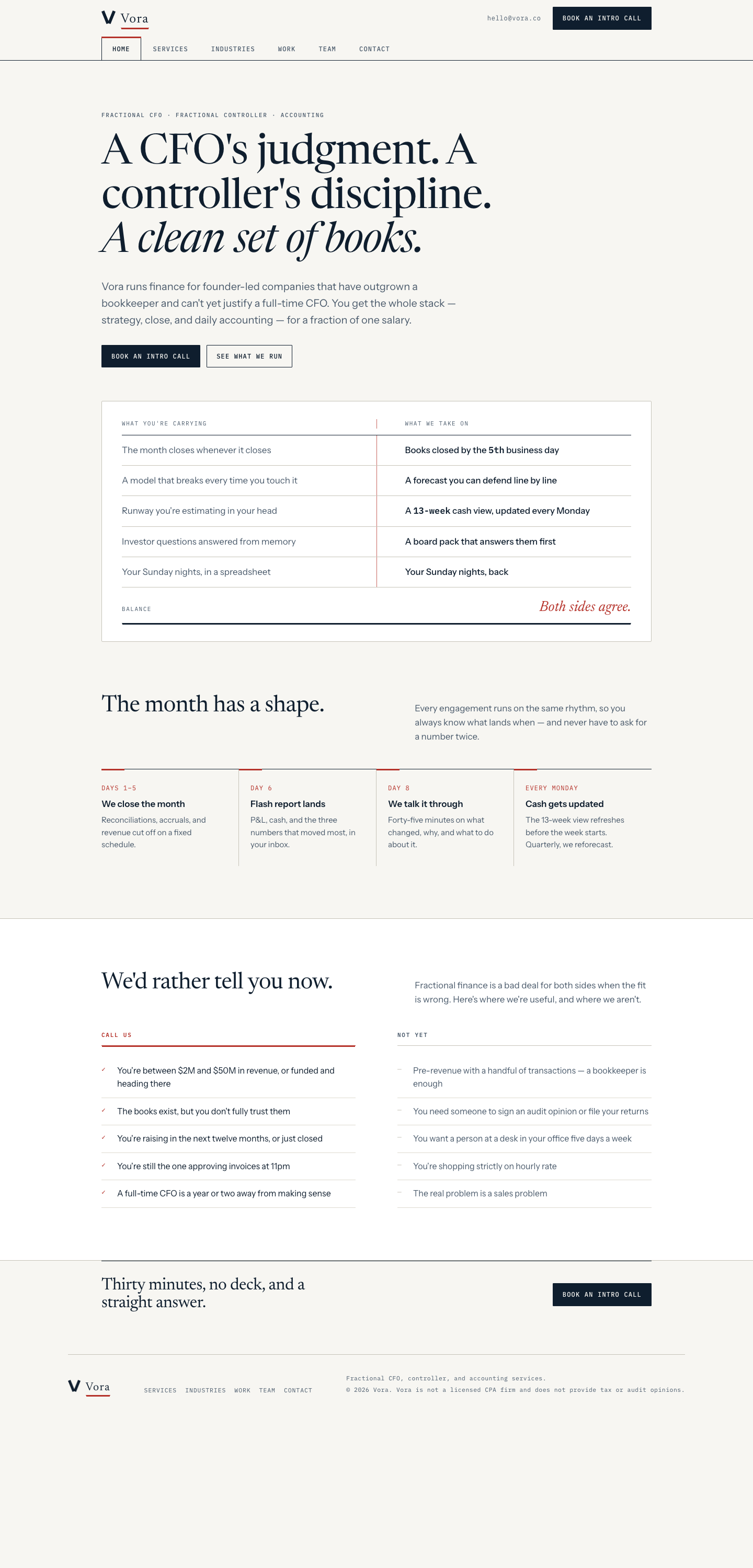
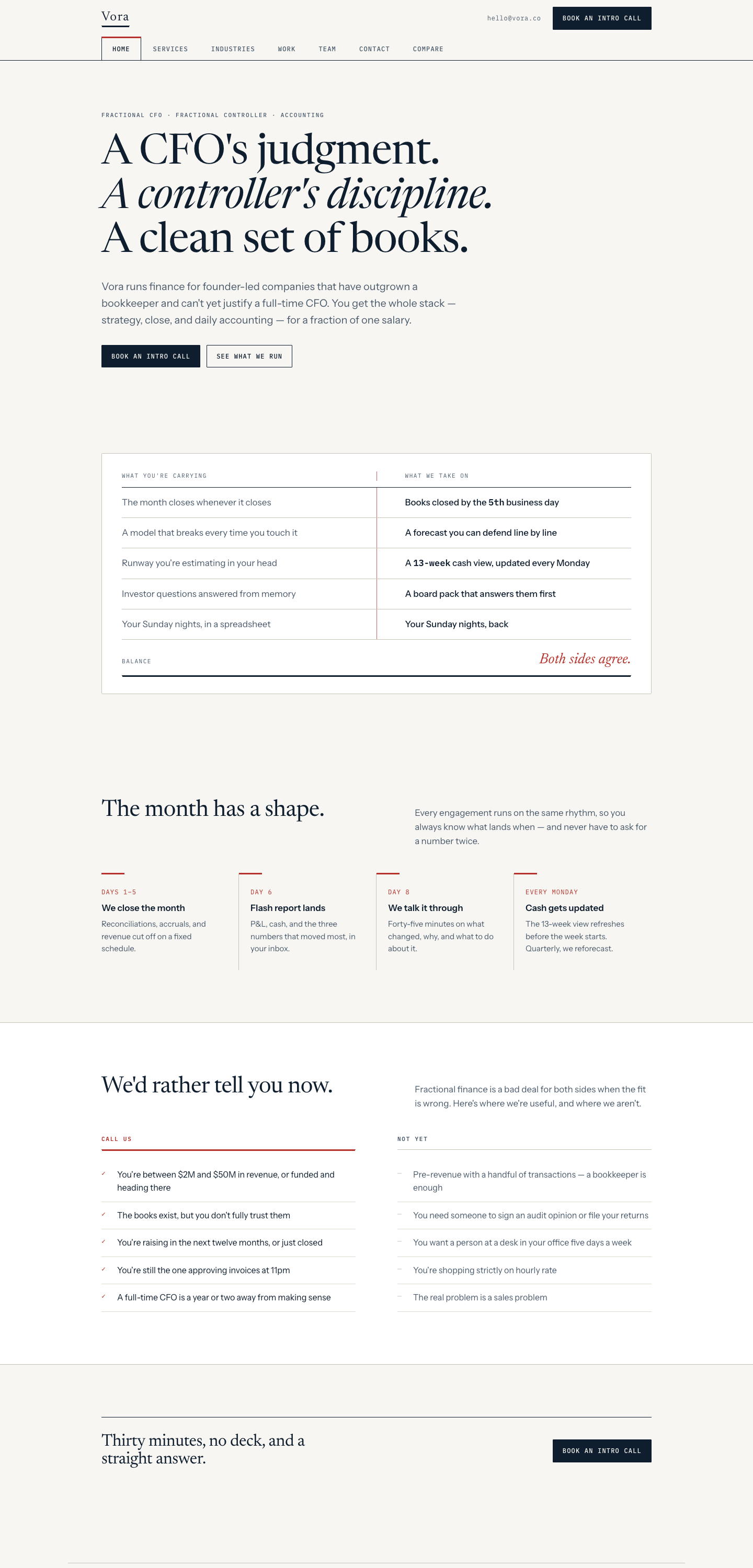
A CFO's judgment. A controller's discipline. A clean set of books.
Vora runs finance for founder-led companies that have outgrown a bookkeeper and can't yet justify a full-time CFO. You get the whole stack — strategy, close, and daily accounting — for a fraction of one salary.
Names withheld at client request. Figures come from the engagement files and cover the first twelve months.
SaaS · $8M ARR · Series A
The model and the bank account finally agreed.
Annual prepays were booked as revenue on receipt, so every strong sales month looked like a blowout and every renewal gap looked like a collapse. We rebuilt revenue recognition, restated four quarters before the raise, and put a deferred revenue roll-forward in the board pack. Diligence closed without a single accounting question.
Close time, before
24 days
Close time, now
5 days
Restated quarters
4
E-commerce · $22M revenue · Founder-owned
Two products were losing money on every order.
Freight and marketplace fees were pooled in one operating expense line, so nobody knew which SKUs paid for themselves. We rebuilt landed cost by SKU, moved fees into COGS, and gave the team a weekly contribution margin report. They repriced two lines and killed a third within a month.
Gross margin, reported
41%
Gross margin, actual
29%
After repricing
36%
Home services · 6 locations · Seller-financed exit
Six locations, one set of books, no comparisons.
Every branch coded expenses its own way, which made the roll-up useless and the sale process painful. We standardized the chart of accounts, split payroll by site, and produced eighteen months of comparable location P&Ls. Two underperforming branches turned out to be a labor problem, not a demand problem.
Months rebuilt
18
Days to data room
11
Locations reported
6 of 6
We'll walk you through a full engagement file on the call.
The same CFO and controller stay on your account for the life of the engagement. You'll have their direct line, and they'll know your business by the second month.
MR
Maya Reyes
Founder & CFO
Fifteen years running finance for software and services companies, including two through acquisition. Leads CFO engagements and every fundraise we support.
Previously: VP Finance, Latchford
DO
Daniel Okafor
Controller
CPA. Owns the close calendar and accounting policy across the portfolio. Has rebuilt more charts of accounts than he'd like to count.
Previously: Audit, Grant Thornton
SL
Sara Lindqvist
Controller
Specializes in inventory and multi-entity work — landed cost, intercompany, and consolidations that hold up under diligence.
Previously: Controller, Brightwell Goods
TN
Theo Nakamura
Accounting manager
Runs the weekly work: reconciliations, AP and AR, payroll, and sales tax. The person who notices the duplicate vendor before it gets paid twice.
Previously: Senior Accountant, Vantage Park
Meet the two people who would actually run your books.
Thirty minutes, no deck. We'll look at what you have, tell you what's missing, and say plainly whether we're the right people for it.
Questions we get in the first call.
Do you replace our bookkeeper?
Only if you want us to. More often we sit above them: our controller sets the policy and reviews the work, and your bookkeeper keeps doing the daily entries.
What systems do you work in?
Yours. We're fluent in QuickBooks, Xero, NetSuite, Bill, Ramp, Brex, Gusto, and Rippling. If your stack is holding the close back, we'll say so and run the migration.
Do you file taxes?
No. We prepare the year-end package and work directly with your CPA so their questions are answered before they ask. If you don't have one, we'll introduce you.
How fast can you start?
Two weeks for accounting and controller work. CFO engagements depend on who's the right match — we'd rather wait a week than assign the wrong person.
What does it cost?
A fixed monthly fee based on scope and transaction volume, quoted after a look at your books. No hourly billing, and no surprise invoices in a month when things get busy.
Send us the short version.
A few lines is enough. We'll reply with what we'd want to see before the call, or with the name of someone better suited than us.
The original, scored — and three ways it could go instead.
A side-by-side diff of the original design against the redesign, a scored ranking of the original, and three alternative directions built from scratch. Every score traces to a count taken from the files themselves.
Ranking the original.
Weighted by business impact. Each score cites the measurement behind it — run tools/measure_designs.py to reproduce every number.
64/100
Headline reading
A genuinely well-designed brochure with a real point of view — and almost no machinery for being found or for converting a visitor who isn't already sold.
Dimension
Weight
Score
Measured from
Design & hierarchy
10%
9/10
6 H1s, 9 H2s, 27 H3s, clean outline. The ledger and cadence devices are distinctive, not template.
Content depth
20%
7/10
1,564 words across 6 sections; 4 named people, 3 case studies. Real depth, but no page beyond the six.
Conversion path
25%
4/10
8 CTAs but only 2 distinct labels; 1 form, 5 fields; the word “quote” appears once and “price” once in 1,564 words.
Trust & proof
20%
3/10
3 numbers with units site-wide. 0 testimonials, 0 client logos, 0 years-in-business, 0 credentials.
SEO foundations
10%
2/10
0 JSON-LD blocks, 0 OG tags, 0 Twitter cards, 0 canonical. One <title> for all six sections.
Technical / crawlability
10%
3/10
Hash-routed SPA: five of six sections are invisible without JS execution. 69,908 bytes, single file.
Correction to an earlier draft of this audit.
An earlier version of these notes claimed the original had “no interior pages, no team, no case studies.”
That was wrong. Measuring the actual file shows the original was already a six-section tabbed SPA
with 4 named people and 3 case studies. The redesign's gains are real but narrower than first stated
— they are structural and conversional, not a content rescue.
Diff: original vs. redesign.
Same viewport, same day, headless Chrome. The original is served alongside this page so you can open it yourself.
BeforeOriginal design
Kept in the redesign
The serif editorial hero, the two-column ledger, and the “month has a shape” cadence row. These are the design's real assets.
Its actual weaknesses
One CTA vocabulary for every intent, three numbers of proof in the whole document, and zero machinery for search.
Unchanged rows are the honest part: the redesign did not fix routing, did not broaden the CTA vocabulary, and added only one unit-bearing number. Those are the next three jobs.
Three alternative directions.
Built from scratch, not templates — each takes a different position on what a fractional CFO site is for. Open any one full-screen.
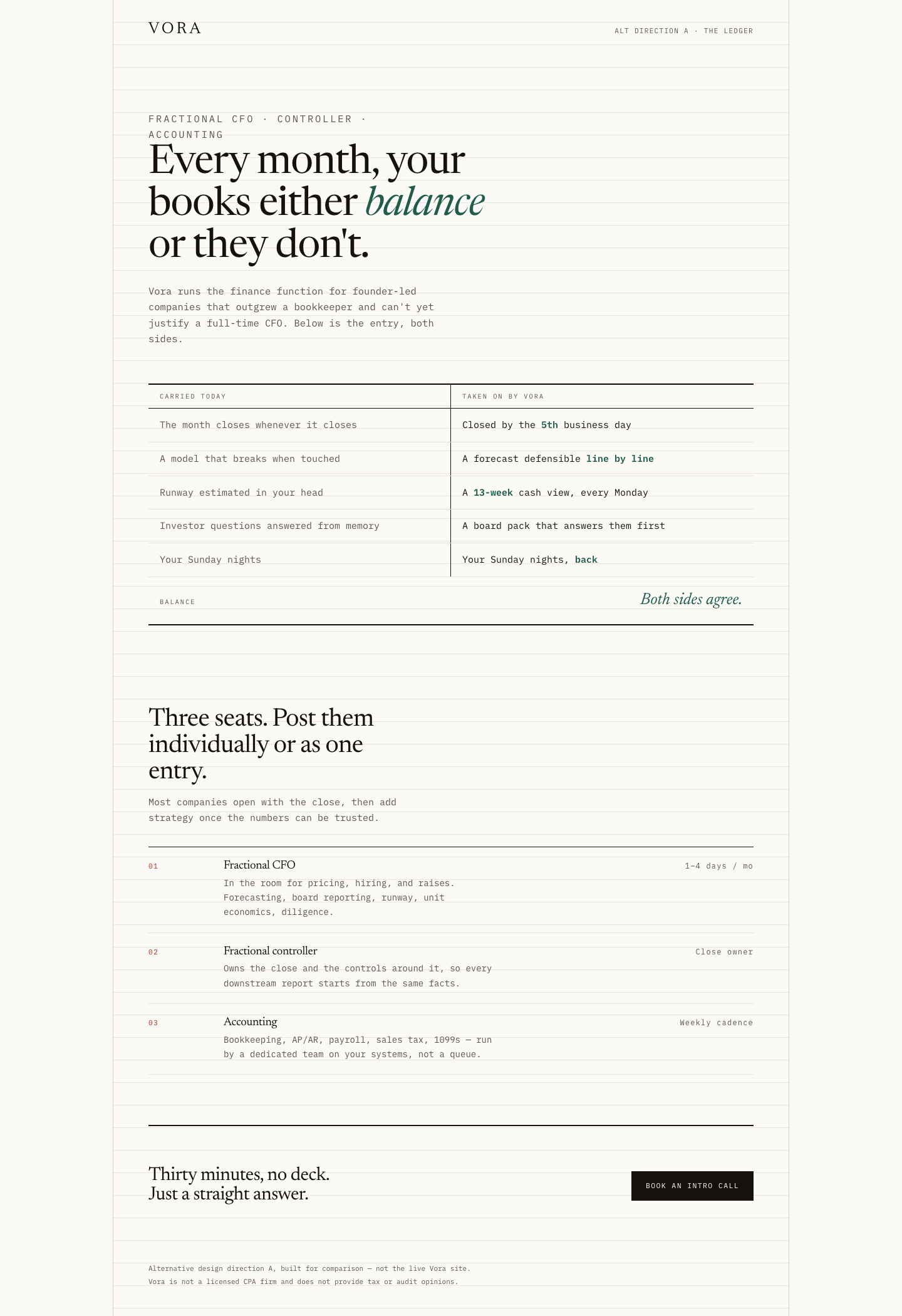
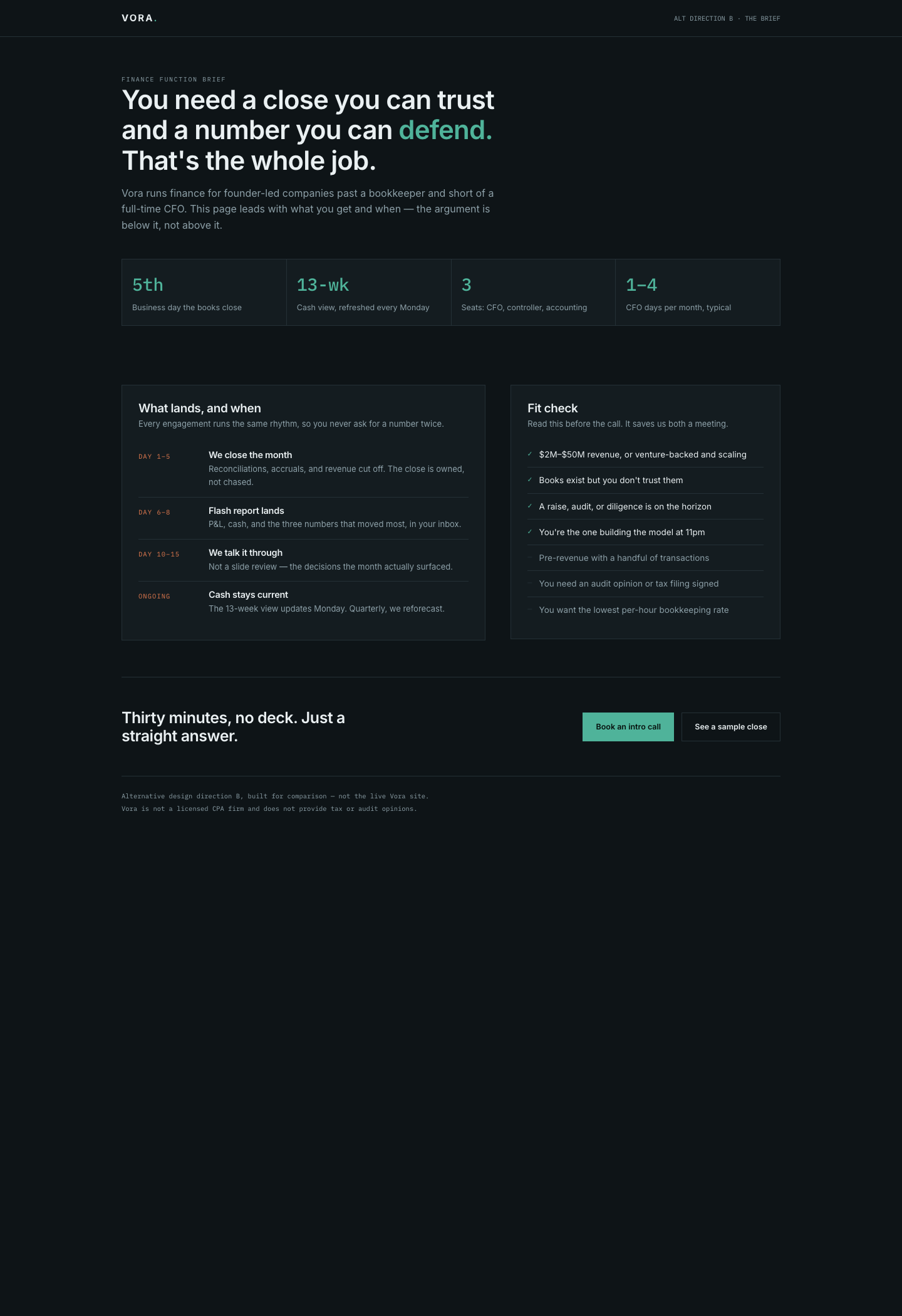
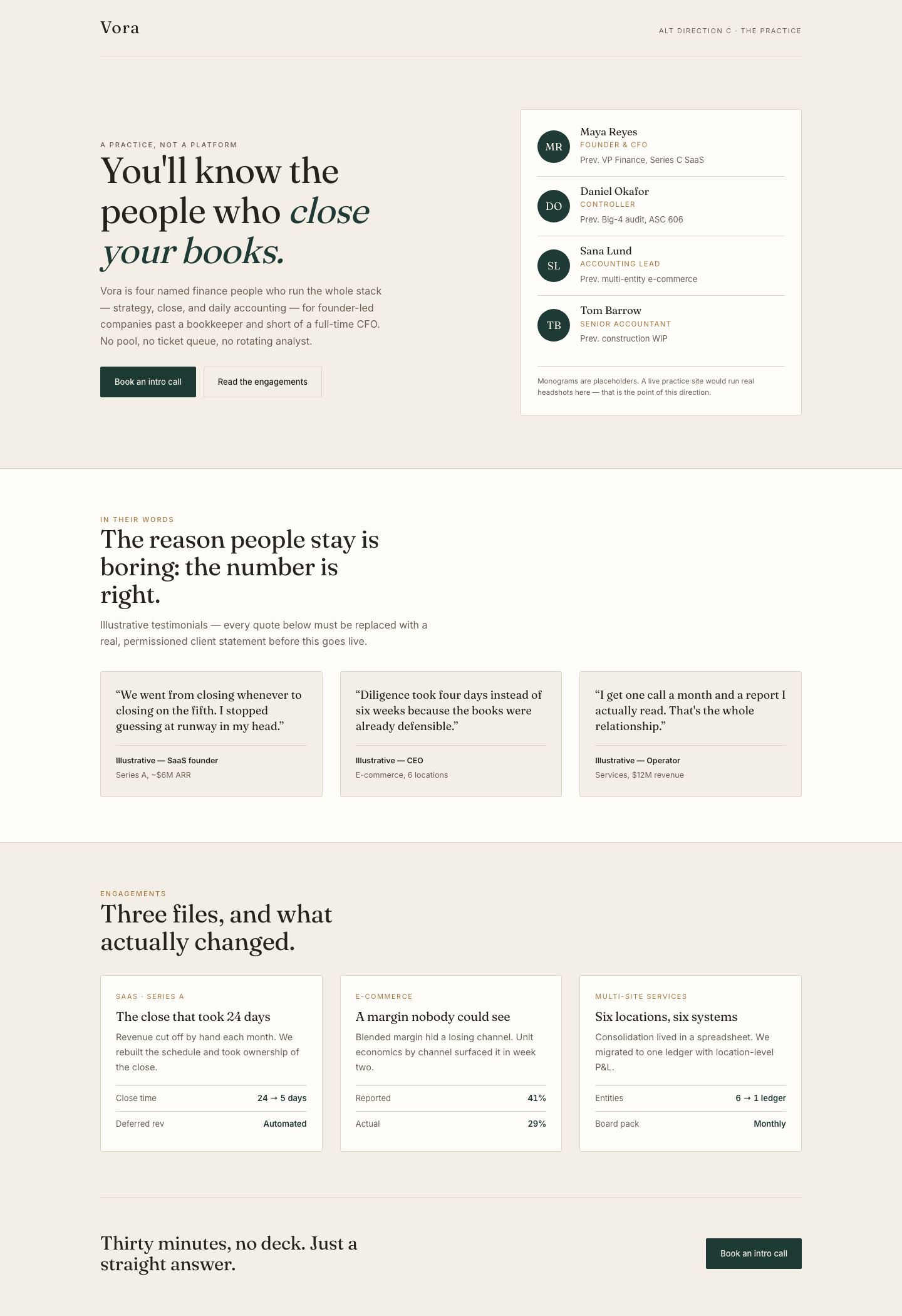
A · The LedgerThe balance sheet as the whole layout. Ruled ledger paper, a real T-account carrying the value proposition, monospace throughout, green for what you gain and rust for what today costs you.Strongest if the buyer is an accountant. Highest risk of reading as austere to a founder.Open direction A →B · The BriefAnswers first. A four-metric KPI band above the fold, a dated cadence table, and a blunt fit-check that disqualifies the wrong visitor on purpose. Dark operator palette.Highest conversion potential — it front-loads the numbers the original hides. Least warm of the three.Open direction B →C · The PracticePeople first. The four named humans are the hero, not a slogan; quotes and engagement files carry the proof. Warm cream, deep green, brass accents.Best fit for a four-person firm whose actual differentiator is “named people, not a pool.” Needs real headshots and permissioned quotes to work.Open direction C →
Recommendation.C (The Practice) for the top of the site — it is the only direction that
exploits the firm's real differentiator — with B's KPI band and fit-check grafted in above the fold
to fix the measured proof and conversion gaps. A is the most distinctive artifact but the narrowest audience.
All three are placeholder-content mockups: every number and quote needs client confirmation before use.
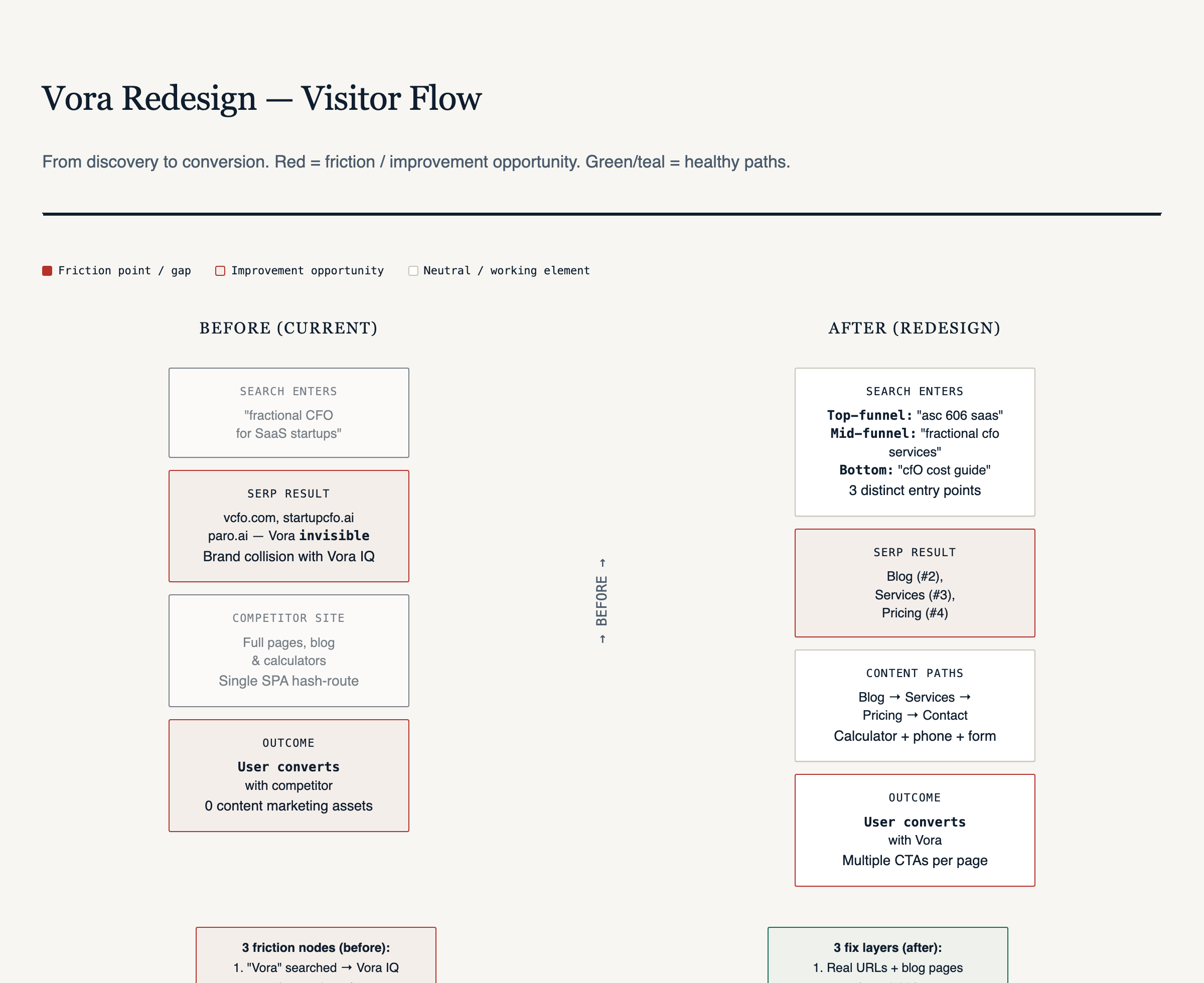
Visitor flow, structural.
Red marks measured friction; the after side splits entry into three intent tiers.